
The St. Andrew's-Sewanee Middle School (grades 6-8) provides a dynamic, hands-on education in a close and caring community. The Middle School curriculum seeks to capitalize on the energy, curiosity, sociability, and love of learning of students in this unique stage of development.
Faculty
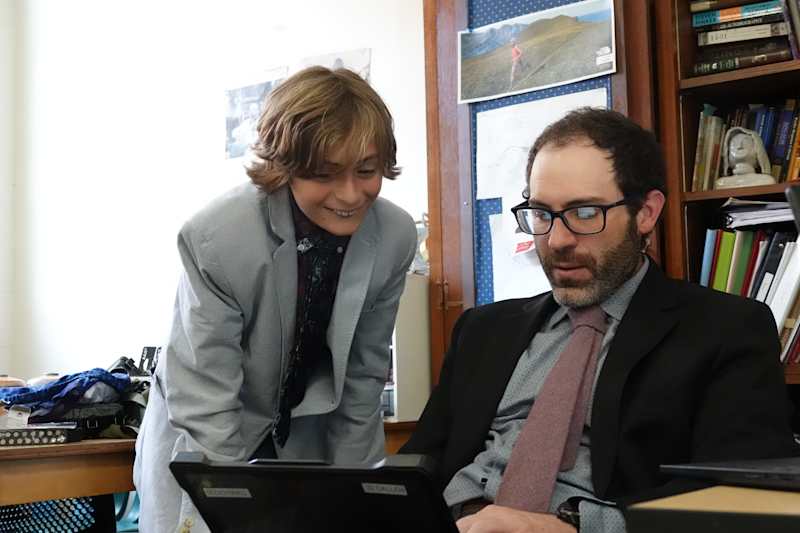
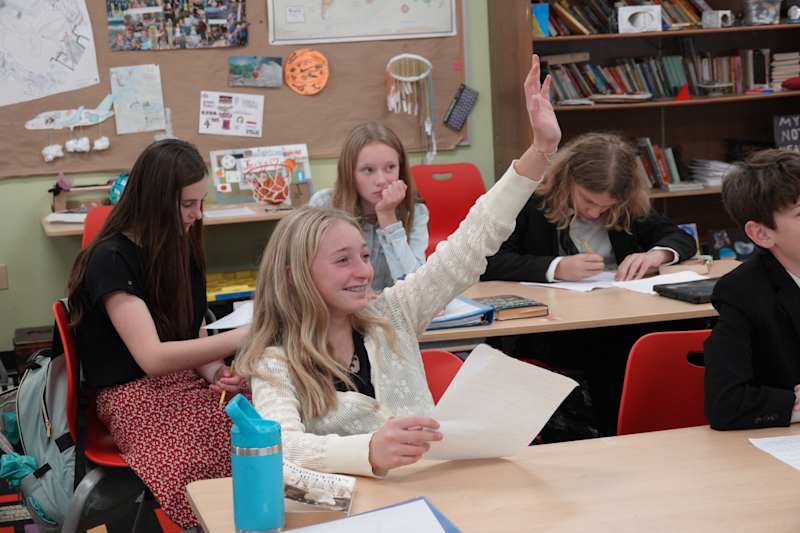
Our dedicated and experienced teachers focus on the special concerns of sixth, seventh, and eighth graders, providing a supportive environment especially designed to foster the academic, social, and personal growth of each middle school student. Teachers encourage and help to develop each child's unique abilities and interests.
I really appreciate the different classes that my daughter is able to take as a sixth grader. I love that you do not push perfection as the main goal. That it's okay to mess up and try again. That it's about effort and experimenting. Learning to think outside the box.
- Former parent/survey
Facilities
The Reishman-Chamberlain Middle School wing offers a discrete space for Middle School students within the school's larger academic complex. In addition to classes in the this wing, students enjoy the facilities of the entire school, including Agee Library, Wade Hall for the Sciences, and McCrory Hall for the Performing Arts.
A School within a School
Middle School students join with the entire school for all-school chapel gatherings but are provided with separate social opportunities (Middle School Fall Festival and End-of-the Year Party, for example) and advisory groups.
While our Middle School maintains a distinct identity, it is very much a part of our entire school community, smoothing the way, intellectually and socially, into the Upper School's rigorous college preparatory classes. As our teachers convey the importance of effective communication, problem solving, and hands-on learning, their emphasis is on teaching students to think, study, organize, evaluate, and express themselves effectively. In middle school, students form the habits and skills that will provide a strong foundation for all that follows.
Extra Support for Middle School Parents
We know that the transition from elementary school to middle school can be almost as tough on parents as it is on kids. That's why our Middle School teachers make themselves extra available to parents as they negotiate how to give their children both more responsibility and more freedom. Throughout the year, parents receive personalized comments on their child's progress, phone calls and correspondence from their child's advisor, and invitations to campus for social gatherings, information sessions, presentations and performances, and volunteer opportunities.
Assessment
We seek to develop and encourage a love of learning in our Middle School students, and our process for assessment reflects that.
Middle School teachers assess student progress and abilities in varied ways, from a simple question asked in class discussion to projects or exams that assess skills, knowledge, and understanding. Eight times per year, teachers report student progress to parents. At the mid-quarter, parents receive a short checklist assessing learning and behavior. At the end of each quarter, teachers provide narrative comments on performance, progress, ability, effort, and attitude.
Narratives include comments, suggestions, and quantitative data. This process highlights a student’s strengths and accomplishments and alerts parents/guardians and the student to weaknesses to be addressed.
A learning focus, rather than a grading focus, allows us to:
- Appropriately challenge students. A single numeric average establishes an artificial upper limit to learning and growth; narratives have no such upper limit.
- Encourage students to focus on their own strengths and weaknesses rather than comparing their progress to their classmates’.
- Communicate student progress clearly.
- See each student’s work in all the aspects evaluated each term rather than in a single numeric grade, which lumps stronger and weaker aspects of performance into an average.
- Nurture internal motivation in students as they are encouraged to learn for learning’s sake.
Quantitative information, homework averages, and quiz and test scores are recorded and used to help evaluate the child's progress and ability. Parents are encouraged to read evaluation reports carefully with their child and to look for evidence that their child is developing skills and knowledge they value. For example, consistently submitting quality homework indicates that a child is organized, persistent, and careful; working successfully on a group project shows that a child is developing negotiation, consensus building, and leadership skills; accurately completing problems on a math test proves that a child has solid computational skills.
Narrative comments are the beginning of a conversation among parents, children, advisors, and teachers about progress, abilities, attitude, and goals, not merely a summation of one quarter in a child’s life.
Eighth grade is considered a transition year between middle school and upper school. Eighth graders are enrolled in two upper school classes – math and language – and receive cumulative numeric grades in these classes in addition to narrative evaluations.
The narrative assessments give a lot more detail about what my child is learning, his behavior, and expectations for his classes. It also shows me how well his teachers know him as an individual. I like the narrative assessments and appreciated the time put into writing them and what was documented.
- Kathy Lindlau, parent
Middle School Curriculum
Music
Middle School music classes introduce students to sight singing, rhythms, vocal production, ensemble performance, music theory, and history. Students learn key signatures, time signatures, and an in-depth musical vocabulary. Emphasis is placed on exposing the student to a variety of music and encouraging an appreciation of all styles of music.
Theatre Arts
Middle School theatre introduces students to the exciting world of the stage. By using improvisation, collaboration, theatre games, and other fun activities, students learn to perform and to support others while they are performing.
Visual Arts
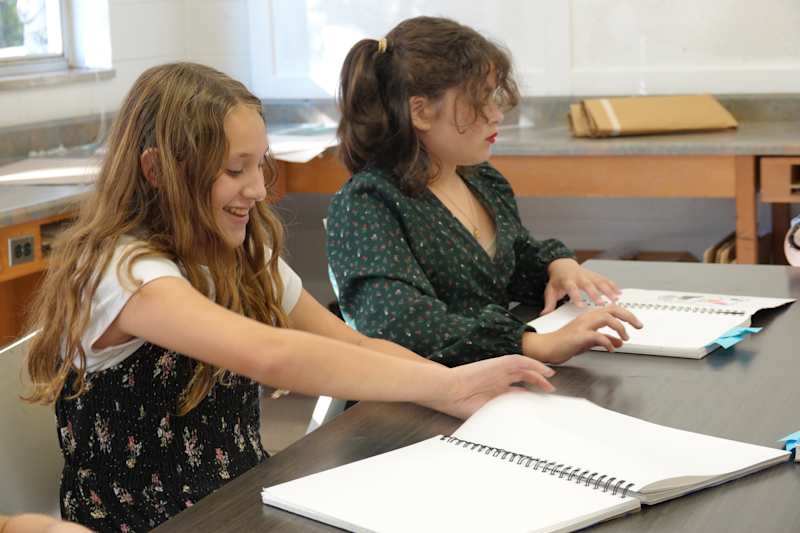
Learning self-expression through the visual arts is an important part of the curriculum at SAS. Middle School art courses allow students to experiment with a variety of media including drawing, painting, printing, photography, digital design, architecture, sculpture, and clay.
The Humanities courses are writing intensive at each grade level, building sequentially on reading, writing, listening, and speaking skills through the exploration of literature and the study of ancient civilizations and world and U.S. history. All middle school students read and write in a variety of genres, with writing skills taught through a workshop approach, emphasizing process equally with product. At each grade level, critical thinking skills and cooperative learning are central.
IDE8 gives 8th graders the opportunity to pursue yearlong independent research and creative projects with the gentle guidance of faculty members.
Students in the Middle School begin with an introduction to language and language study through a full year of Latin and Classical Studies in grade 6 and Spanish language study in grade 7. Beginning in eighth grade, students choose between Latin and Spanish as their primary course of language study and commit to two years of the same language. The middle school years are an excellent time to introduce a second language to young people, and SAS is committed to making language available to students in the middle school in a way that is both meaningful and fun.
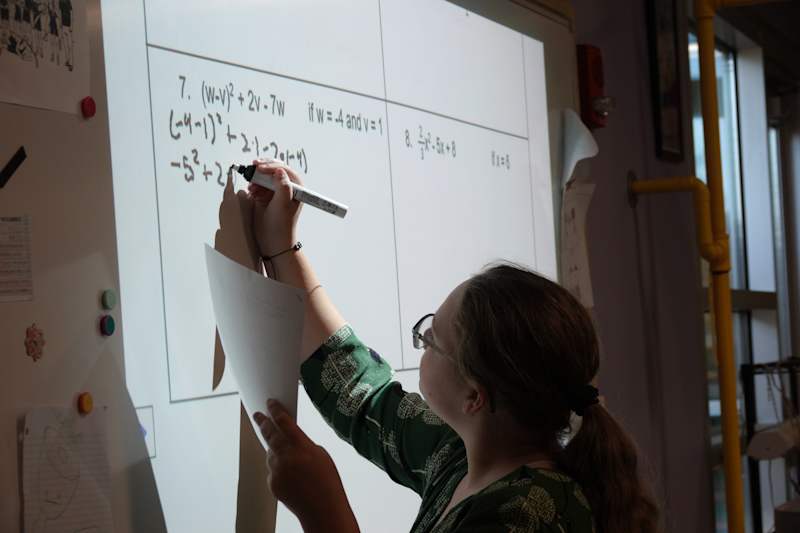
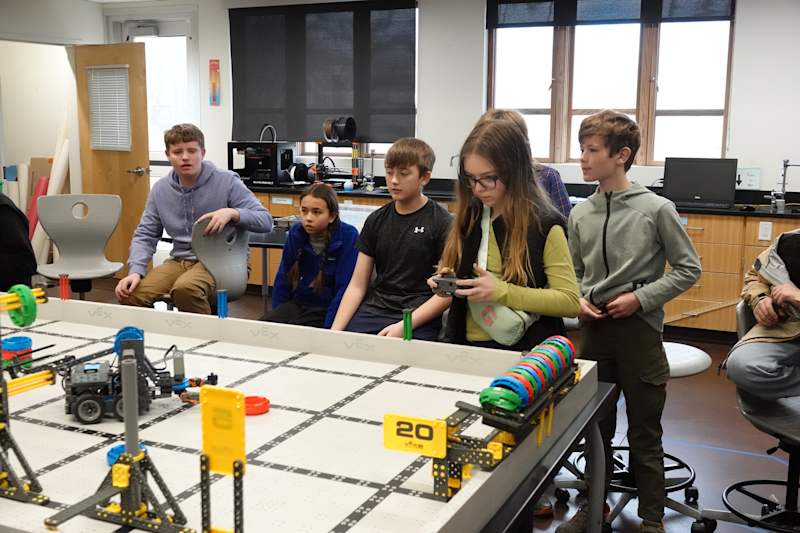
The Middle School math curriculum is designed to strengthen students' basic math skills in preparation for higher level math courses. In addition to focusing on content, the preparation includes helping students to overcome any pre-existing math phobias and to see the real-life value and fun of math. The emphasis is jointly on learning how to “do" math and striving to understand why it's done that way. A solid understanding of the math fundamentals are designed to prepare students for explorations in algebra, geometry, and beyond. Eighth graders have a choice of pre-algebra or algebra I. Students with a passion for mathematics are encouraged to participate in American Math Competitions and Math League Contests.
Adventure Education
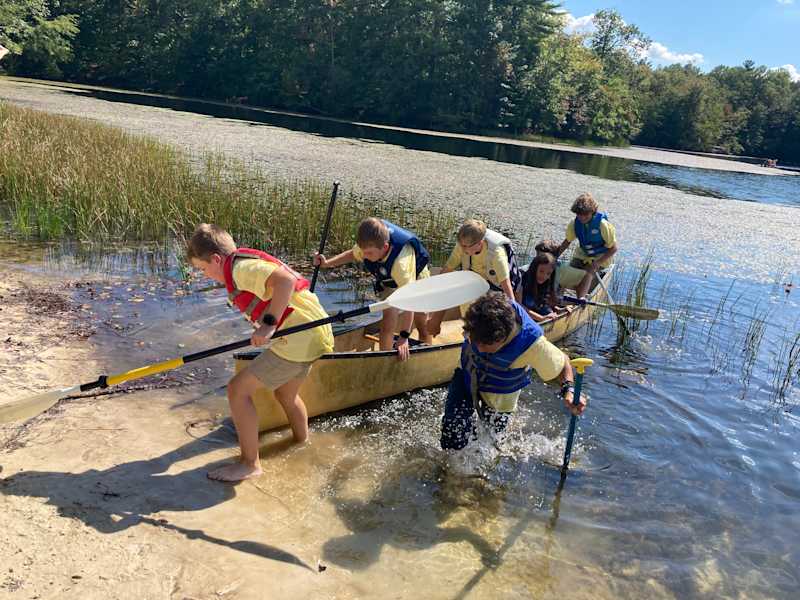
Adventure education is an opportunity for Middle School students to learn to safely explore and enjoy our natural world. The school's 550-acre campus is the setting for activities that include hiking, games, construction projects, map reading, orienteering, farming, and more.
Students use their imaginations and hone their sense of adventure as they work on team building, communication and conflict resolution, and problem solving skills. As the students progress through Middle School, they move from exploratory activities to more advanced wilderness skills.
The physical education course is designed to increase students' stamina, endurance, and overall fitness. Students learn strategies for positively addressing their mistakes as well as the mistakes of their classmates. Age-appropriate activities are designed to improve fundamental skills while promoting self-esteem and a sense of well being. Lead up games, hand-eye coordination activities, and the concept of "fierce and friendly" play are emphasized.
At SAS, Middle School students assume the role of scientists as they explore the life, physical, and earth sciences and their interconnections. The entire campus is their laboratory as they pursue many hands-on lab and outdoor projects, culminating in an independent research project. Students learn accurate data recording procedures by maintaining detailed lab notebooks, learning to write formal lab reports by the end of 8th grade science. They are challenged to look for the “why" behind the facts and strengthen critical thinking skills.